
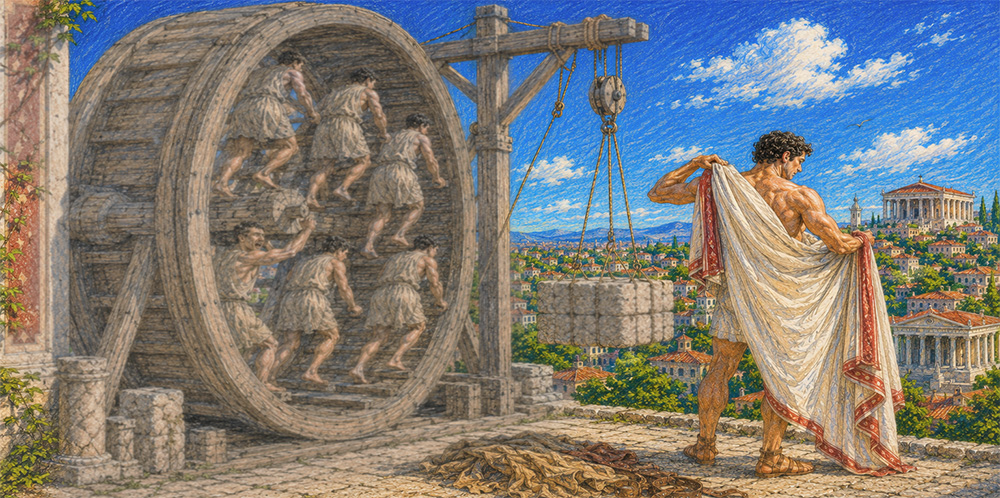
In the Rome of the Caesars, a man's whole fate could be read in a single word: servus or dominus. Slave or master. The servus rose when another bade him rise, dined on whatever was set before him, and walked wherever another pointed his sandals. The dominus did the pointing. One man's days were written by a hand not his own; the other held the stylus.
We flatter ourselves that this distinction died with the Western Empire—that we are all free citizens now, each a dominus in his own right. Yet watch a thoroughly modern person open his banking app before he has so much as had his coffee, and the old hierarchy is alive and well. The number rises; he is permitted to feel buoyant. It falls; he is commanded to despair. His mood, his posture, the entire climate of his inner life—dictated by a figure he did not author. That, in any century, is the bearing of a servus.
Neville Goddard spent a lifetime pressing one scandalous idea: that no circumstance has ever once been the cause of your life. Circumstance is the effect. The cause—the only cause there has ever been—is the state of consciousness you consent to occupy. To grasp this is to receive, quietly and without ceremony, your own papers of freedom.
Two Houses, One Door
Picture two households standing side by side on the Palatine.
In the first lives the servus. He is forever consulting the world to learn how he ought to feel. He reads the headlines and adjusts his hopes accordingly; he studies the faces of others for permission to be at ease. Asked how things are going, he recites the verdict the facts have handed down—business is slow, the doctor was grave, the times are hard—and believes he is merely being honest. In truth he is taking dictation.
In the second house lives the dominus. He sees the same headlines and the same long faces, but he does not take his orders from them. He has found the one room from which the whole estate is governed—the imagination—and he declines to hand the keys to any passing fact. He sets the climate within, and then, with a patience that looks almost like indolence to the untrained eye, waits for the weather without to come round to his way of thinking.
Here is the part worth sitting with: both men live behind the same door, on the same hill, under the same indifferent sky. Nothing in their outward situation requires one to be a slave and the other a master. The whole difference lies in which is giving the orders and which is taking them.
The Tyranny of Fortuna
The servus worships, whether he names her or not, the goddess Fortuna.
She is the perfect deity for a temperament that wishes to remain a servant, for she asks nothing and promises everything. She turns her great wheel, and you are borne up or flung down by no merit and no fault of your own. To live under Fortuna is to live in perpetual suspense—refreshing the page, knocking on wood, reading the omens, hoping the wheel stops kindly this time. It is exhausting precisely because it is passive: all the anxiety of a gambler and none of the agency of a player.
We worship Felicitas instead, and the distinction is the whole of our teaching. Fortuna is luck—arbitrary, external, forever happening to you. Felicitas is blessedness cultivated: an inner condition you assume on purpose and then tend like a garden. The Roman who set Felicitas above Fortuna was making a radical wager—that the well-being he carried within was more real, and more durable, than the lottery of events. Neville would have called him an apt pupil. The master does not beg the wheel to favor him; he steps off it entirely and becomes the still point the whole contraption turns around.
 "I Am" Is a Command, Not a Confession
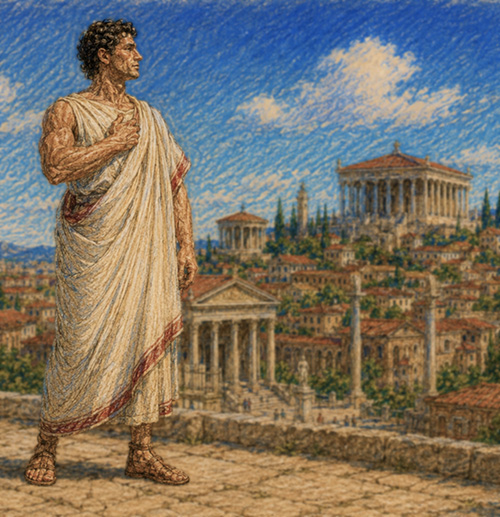
Of all the powers a Roman master held, the most absolute was imperium—the bare right of command, the authority by which a word became a deed.
You hold an imperium of your own, and you wield it dozens of times a day, usually to your own ruin. It lives in two small syllables: I am. Whatever you join to those words you do not merely describe—you decree. I am exhausted. I am the sort of person things never work out for. I am behind, overlooked, unlucky. The servus utters these sentences as though reporting the news, never suspecting that he is the one writing it.
Neville's teaching here is breathtakingly simple: I am is the name of the only god you will ever meet, and you speak in his voice every waking hour. The master, knowing this, grows exquisitely careful about what he yokes to that holy verb. He will not sign a decree he has no wish to see enforced. When the facts demand he confess to lack, he declines—not by protesting loudly, but by quietly assuming the feeling of the man for whom the thing is already done. Mens movet mundum: mind moves the world. And it moves it through the sovereign little phrase you have been squandering since you learned to talk.
How a Master Holds His Ground
Anyone may proclaim himself a dominus for an afternoon. The whole art is in holding the line—and here the Romans, who built an empire chiefly through a refusal to break ranks, have much to teach the would-be master of his own life.
To assume a state is easy; to persist in it while the senses jeer is the entire discipline. Neville said it plainly: an assumption, though false when you make it, will harden into fact if you persist in it. The master therefore treats his chosen state as a legionary treats his place in the line—he does not abandon it merely because the moment looks unpromising. He holds.
And when a day has gone badly—when he has slipped, taken dictation, played the servant out of old habit—he does not lie awake rehearsing the grievance. He performs what Neville called revision. In the quiet of the evening he replays the offending scenes as he wished them to go, rewriting the day in imagination before he sleeps. The servus relives his worst hours until they are worn smooth as a temple step; the master edits the record and submits the corrected version for filing. The same memory, the same evening, the same hill—and an entirely different life proceeding from it.
Granting Yourself Manumission
Rome had a ceremony called manumissio—the formal freeing of a slave. The master laid his hand upon the servant, spoke the words, and a man who woke a servus went to bed a citizen. What is remarkable is how little of the world had to change for everything to change: the same body, the same city, the same labors perhaps, and yet an utterly different station, because the relation of command had been rewritten.
You are, improbably, both master and slave in the one household that finally matters—which means the manumissio is yours to perform, and you need no hand but your own. You need not wait for the circumstances to improve, the wheel to turn, the verdict to soften. You need only stop taking dictation from a world that was always meant to take dictation from you.
So choose this morning, before the app and the headlines and the long faces have their chance to issue orders. Decline the part of the servus. Assume the state of the man for whom it is already well, and hold it as Rome held its lines—calmly, stubbornly, as though the outcome were never in doubt. The circumstances will arrive in their own good time, a little out of breath, to confirm what you settled at dawn.
Felicitas, not Fortuna. The wheel is for those who consent to ride it. You were born to step off—and to discover, with a freeman's quiet astonishment, that the ground was solid all along.