
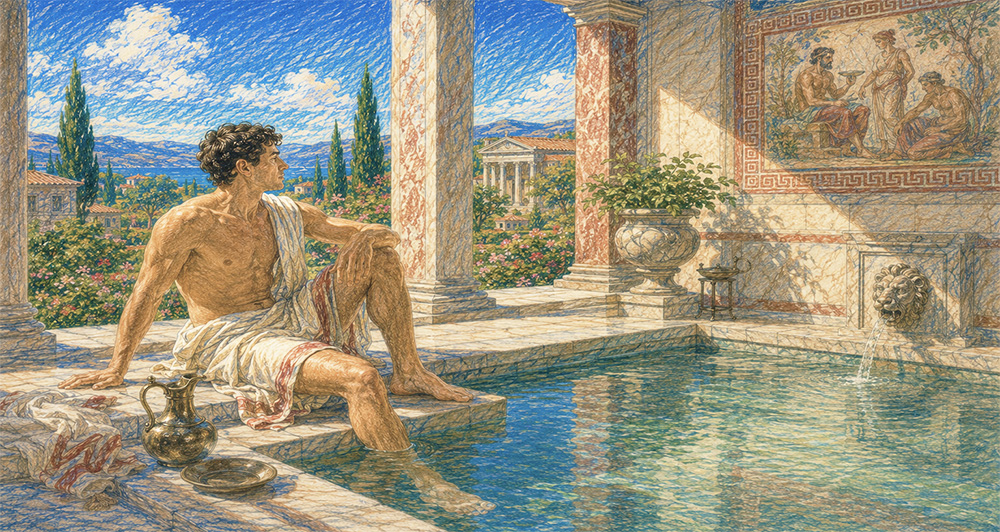
There is a particular look that crosses a capable person's face when you suggest he take an afternoon off. It is not relief. It is suspicion, faintly tinged with guilt, as though you had proposed something mildly disreputable. He has been taught, by a culture that measures a life in deliverables, that rest is a thing one earns in small rations and feels slightly ashamed of, and that the only honest alternative to work is sloth. So he never quite rests. He either drives himself until the machine seizes, or he collapses onto the couch and calls the wreckage "relaxing," then wonders why he rises from it more tired than he lay down.
The Romans would have pitied him, though not for the reason you would expect. They would have pitied him because he had lost the knowledge of otium, and with it the ability to tell the difference between rest and ruin.
The Lustratio is the rite of clearing: the sweeping-out of worry, resentment, and the accumulated clutter of the inner household, so that something new may be called in. We are inclined to imagine that clearing as an exertion, one more line on the ledger of self-improvement. But the deepest clearing the Romans knew was no exertion at all. It was a particular, disciplined, dignified stillness, and it bears almost no resemblance to the thing that wears its clothes.
What the Romans Meant by Doing Nothing
Begin with the word, which holds a small revelation. The Latin for business, for the entire grinding apparatus of affairs and obligations, was negotium: literally neg-otium, "not-leisure." Sit with the grammar of that for a moment. The Romans did not define leisure as the absence of work; they defined work as the absence of leisure. Leisure was the positive term, the natural and proper condition of a free man. Business was the interruption.
This was no license for indolence. Otium was the soil in which the highest things grew. It was in the unhurried quiet of the country villa that Pliny composed his letters and Cicero his philosophy; it was to his leisure, not away from it, that Seneca withdrew to write the works we still read two thousand years on. The Greeks, from whom the Romans borrowed the notion, called this leisure scholē, and left us, as a souvenir, the word school. Leisure, in the old understanding, was not the holiday from learning. It was the seat of it.
The men who prized otium were not loafers. They were frequently the busiest men of their age, who grasped that the mind does its finest work only when it is at last permitted to stop thrashing. Cato said of Scipio Africanus, the general who broke Hannibal, that he was never less idle than when idle, and never less alone than when alone. There is the whole secret in a sentence. To the untrained eye, the great man at his leisure appeared to be doing nothing. In fact he was doing the one thing that cannot be done at speed.
The Counterfeit Wears the Same Robe
Here we must draw the line with some care, because otium has a double, and the double is remarkably convincing from across the room.
Picture the man who has simply let everything go. He does not work, but neither does he rest in any sense a Roman would recognize. He has stopped tending his affairs, stopped tending his rooms, and stopped tending the one thing that finally matters: his own mind. His days have no shape, because he has declined to give them one. He calls this freedom. It is nothing of the kind.
From across that room, he and the man of otium are hard to tell apart; both, after all, are not working. But the likeness ends at the surface. The man of otium has set down the oars. The idle man has abandoned the helm. One has chosen stillness; the other has merely surrendered to gravity. And the difference declares itself, infallibly, in the single place that matters: the state of the inner household.
For here is what no one warns the idle man about. A cleared room does not stay cleared on its own. Leave the inner house unwatched and it does not remain serenely empty; it fills, quietly and without your leave, with the worst class of tenant. The low hum of worry. The old grievance hauled out and turned over again. The formless resentment that thrives in any vacancy. The idle man's quiet is not peace. It is an unguarded house, and something always moves into an unguarded house.
This is why the Romans were careful to qualify the leisure they admired. Cicero's ideal was not otium merely, but otium cum dignitate: leisure with dignity. The dignitas was not ornament; it was the entire distinction. Leisure without dignity is not a lesser grade of otium. By the Roman reckoning it is not otium at all. It is the bum on the bench, who has surrendered his self-respect and the governance of himself, the very thing that would have made his rest worth anything. He has not been liberated. He has merely been let off the leash, and a man off the leash is not free. He is only unsupervised.
Releasing the Grip, Not the Self
All of which returns us to the work of the Lustratio, and to a confusion that quietly wrecks more manifesting practices than any other.
You will hear it said, rightly, that you must learn to let go. Stop forcing. Stop straining toward the outcome. Stop lifting the lid every few minutes to see whether the thing has arrived, since the watched pot famously declines to oblige. This is sound counsel, and otium is its purest expression: the deliberate release of negotium, of the white-knuckled grasping that mistakes anxiety for effort and squeezes the future so hard it cannot breathe.
But notice exactly what is being released. You are letting go of your grip on the outcome. You are not letting go of yourself. These are altogether different acts, and the idle man has confused them catastrophically. He heard "release" and released the wrong thing. He let go of his standards, his attention, his stewardship of his own thoughts, while keeping, if anything, a tighter grip than ever on his grievances.
True release runs the other way. It opens the hand that clutches the result and closes the hand that guards the mind. The man of otium watches his inner household more attentively in his stillness, not less, precisely because he knows what moves into quiet that is left untended. He sweeps. He sees the grievance reaching for the doorknob and declines to admit it. His rest is not a vacancy; it is a tended garden in winter, dormant at the surface and alive at the root. And a tended quiet is the only soil in which the assumed wish takes hold. The grasping hand has nothing free to receive with. The open one does.
How to Rest Like a Free Man
So how does one practice the genuine article rather than its shabby twin? A few marks set it apart, and not one of them requires a villa in the Sabine hills.
The first is that otium is chosen, never collapsed into. You enter it as you would enter a room, on purpose and through the door, rather than falling into it because your legs gave out beneath you. The choosing is what makes it yours.
The second is that it has edges. The Roman who understood leisure best was Cincinnatus, who left his plough to rescue the republic and then, the crisis past, walked back to his furrow without a backward glance. He could rest because he could also stop resting. Leisure with no end is not otium; it is merely drift with better lighting. Enter your stillness deliberately and leave it deliberately, and it will serve you at both ends.
The third, and the one that does all the heavy lifting, is that you keep watch. To rest well is not to switch the mind off but to tend it gently: to notice when the old tenant comes shuffling back toward the door, and to send it on its way without ceremony. This is dignitas in practice, the quiet self-respect of a man who, even at his ease, declines to let his own house go to seed.
Do this, and you will recover what the Romans knew and we have very nearly forgotten: that to do nothing, beautifully, is not the opposite of a well-ordered life. It is among its highest accomplishments. The mind that moves the world, mens movet mundum, does its deepest work not in the frenzy of negotium but in the cultivated calm that arrives once the oars are shipped. Felicitas, not Fortuna: the rest worth having is never the accident of an aimless afternoon. It is the earned composure of a free man who has remembered, at last, how to sit still with dignity and let the world come to him.