
We’re all used to thinking of the brain as the CEO of the body — the one calling the shots, making decisions, and (sometimes) overthinking things into the ground. The heart? Well, it’s just the plumbing department, right? Pumps blood, keeps the lights on, end of story.
Except… that’s not the end of the story. Not even close.
Over the last few decades, science has quietly been rewriting the script. The heart is far more than a simple pump. It has its own complex nervous system, produces powerful electromagnetic fields, and sends more information to the brain than the brain sends to it. Yes — the “plumbing” has been talking to the “CEO” all along, and in many ways, it’s the heart that sets the tone for the entire operation.
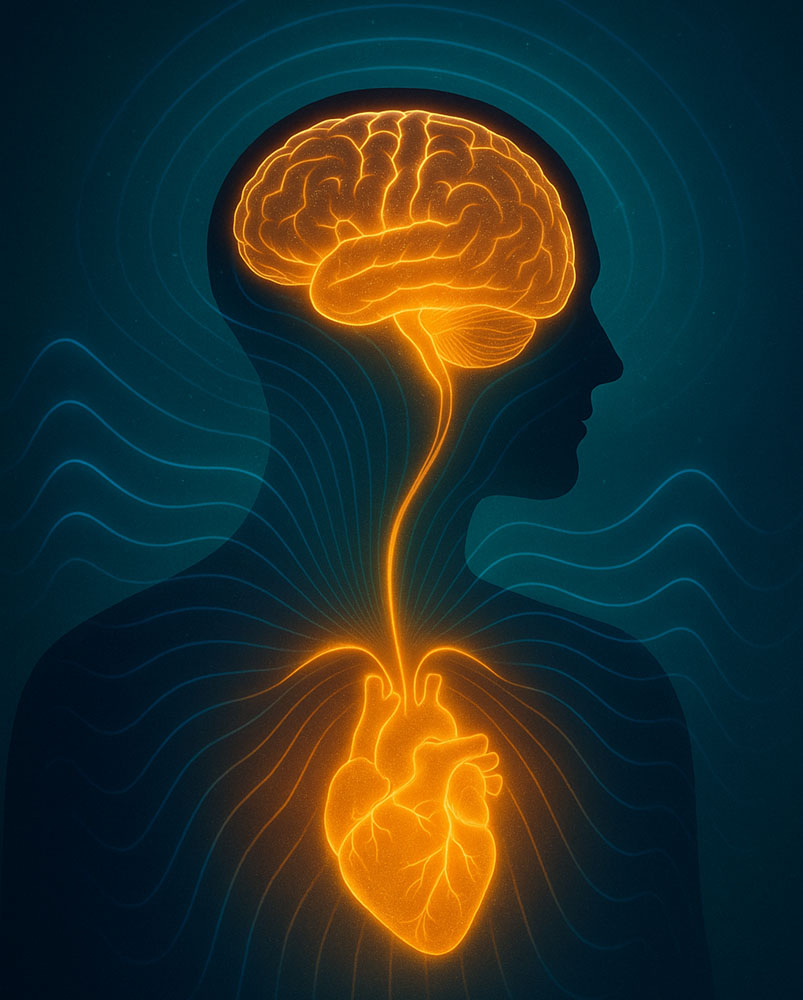 And when the two are in sync — when your heart and brain operate in harmony — something amazing happens. It’s called heart–brain coherence, and it’s not just some poetic metaphor. It’s measurable, trainable, and it can change the way you think, feel, and create your life.
What Exactly Is Heart–Brain Coherence?
Imagine two musicians. One is playing a smooth jazz riff, the other is hammering out a heavy metal solo. Technically, they’re both talented, but together… it’s chaos. Now imagine they start listening to each other, matching rhythm, harmonizing. Suddenly, it’s magic. That’s what coherence is — harmony between the heart and the brain.
From a scientific standpoint, heart–brain coherence happens when your heart’s rhythm (measured as heart rate variability, or HRV) becomes smooth and regular. This pattern tells your brain, “All is well, you can focus, you can create, you can thrive.” The brain responds by shifting into states that improve clarity, decision-making, and emotional stability.
Incoherence, on the other hand, is like that heavy metal–meets–jazz disaster. The heart rhythm is jagged and erratic, the brain’s stress centers light up, and suddenly you’re reacting to life instead of creating it.
Your Heart Has a Brain of Its Own (Literally)
Here’s the part that still blows people’s minds: your heart has about 40,000 neurons — nerve cells — all working together in what scientists call the cardiac nervous system. This “little brain” in your chest processes information, makes decisions, and sends instructions to the big brain upstairs.
And the heart doesn’t whisper its messages — it shouts them. The electromagnetic field produced by your heart is about 100 times stronger electrically and 5,000 times stronger magnetically than the field produced by your brain. This field extends several feet around your body, which means you’re broadcasting your emotional state into the space around you whether you realize it or not.
Ever walked into a room and felt the tension without anyone saying a word? Or been drawn to someone who just radiated calm and warmth? That’s not woo-woo — that’s physics. You’re picking up on heart-generated signals.
The Science (And the Magic) of Coherence
When you shift into coherence, your entire body benefits:
- Brain performance improves — The prefrontal cortex (your “thinking brain”) gets more blood flow, so focus, problem-solving, and creativity all get a boost.
- Stress drops — Coherence reduces activity in the amygdala, your brain’s fear center. That means less fight-or-flight reactivity.
- Hormones balance out — Coherence increases DHEA (a vitality hormone) and reduces cortisol (the stress hormone).
- Immune function strengthens — Smooth heart rhythms support the immune system, helping you resist illness.
- Emotional resilience skyrockets — You recover faster from setbacks, both physically and mentally.
This is where it links beautifully to the Law of Attraction. Incoherence often comes from fear, frustration, or overwhelm — states that keep you focused on what you don’t want. Coherence, by contrast, puts you in a balanced, emotionally elevated state — exactly the sweet spot for clear intention and aligned action.
How to Create Heart–Brain Coherence (in Under Two Minutes)
The best part? You can train coherence like a muscle, and it doesn’t take months of meditating in a Himalayan cave.
One of the most well-studied techniques comes from the HeartMath Institute, which has been researching this field for decades. Here’s a simple way to do it:
- Shift your focus to your heart area. Put your hand on your chest if it helps.
- Breathe slowly and deeply. Aim for about five seconds in, five seconds out. Imagine the air flowing in and out through your heart.
- Activate a positive emotion. Think of someone you love, a place that makes you feel peaceful, or a memory that fills you with gratitude. Really feel it.
- Hold that state for a minute or two. You’ll notice your body relaxing, your mind quieting, and a gentle clarity setting in.
It’s like hitting the “sync” button between your heart and brain.
The Role of Emotion — Your Heart’s Native Language
Here’s the kicker: your brain mostly speaks in logic, but your heart speaks in emotion. If you try to “think” your way into coherence without genuinely feeling it, the heart won’t buy it. This is why affirmations or visualizations sometimes feel flat — they need the emotional charge to carry them.
Gratitude, compassion, care, love — these emotions smooth your heart rhythms like nothing else. And they’re not just nice feelings; they’re powerful physiological states that make your whole system work better.
What Coherence Means for Manifestation
Let’s connect the dots.
Incoherence keeps your energy scattered. You set an intention, but your emotional state broadcasts something else entirely — doubt, frustration, or worry. The mixed signal leads to mixed results.
Coherence, however, aligns your mental focus with your emotional broadcast. You’re thinking about your goal andfeeling as though it’s already here. Your heart and brain are sending a unified signal into your own nervous system, into your decisions, and (if quantum physics is right) into the field of reality itself.
It’s the difference between trying to pick up a radio station with static versus tuning in perfectly. Same intention, completely different clarity.
Practical Ways to Weave Coherence Into Your Day
- Morning tune-up: Spend 2 minutes in heart–brain coherence before you check your phone. Set the tone for the day instead of reacting to it.
- Before big conversations: Coherence can help you speak calmly, listen deeply, and connect authentically.
- Creative sessions: Writers, musicians, and problem-solvers often find ideas flow more easily in coherence.
- During stress spikes: Notice your tension, pause, and run through the coherence steps — it’s like an emotional reset button.
The Bottom Line
Heart–brain coherence isn’t just another self-help buzzword. It’s a bridge between science and lived experience, between physiology and possibility. It’s proof that the way you feel is not just a reaction to life but a powerful driver of the life you create.
So the next time someone tells you to “think with your head, not your heart,” you might smile and know better. The real magic happens when the two are in sync — when the CEO listens to the music coming from the orchestra pit, and together they make something worth hearing.
Your brain may run the numbers.
Your heart sets the tone.
And when they play together? That’s when the real masterpiece begins.