
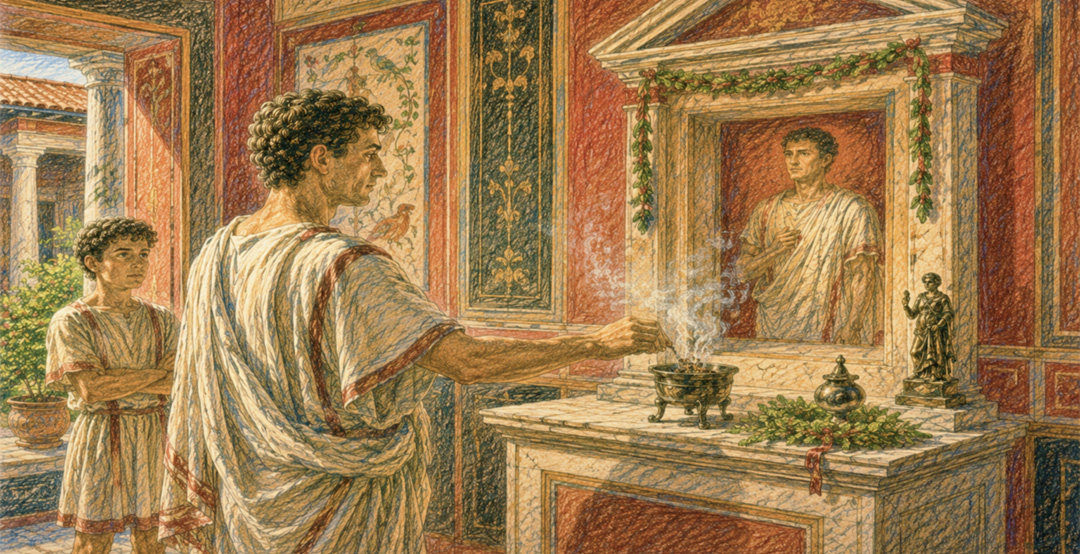
On his birthday, a Roman of any standing did something we have quietly stopped doing. He did not tot up his achievements or take stock of the year's gains. He poured wine, lit incense, laid a garland and a cake at the little shrine by the hearth, and toasted not himself but the spirit that had walked beside him since his first breath: his genius.
We have worn that word down to mean a clever outlier, the rare man with the gift. The Romans meant something far stranger and far kinder. Your genius was not a talent you might or might not possess; it was a guardian-self that every person carried, born with you and bound to you for life, held to be the truest and best version of the man you were. And here is the part that turns the whole idea into something a modern reader can actually use: your genius was understood to want you to flourish. It was on your side from the start.
Which raises the only question worth a reader's time. If each of us came into the world accompanied by a guardian-self that wanted us to thrive, then what on earth holds anyone back? The Romans had an answer. So, it turns out, does the laboratory. They are very nearly the same answer, and it is far gentler than you fear.
The Spirit That Wanted You to Flourish
The word comes from gignere, to beget, the same root that gives us generate and genus. The genius was the generative spark, the life-force that animated a man, and every man had one from birth. Women carried the equivalent, called the Juno. It was no reward for merit and no measure of brilliance; it was simply the part of you that did the living, pictured always as the idealized version of yourself.
A Roman kept his genius at the lararium, the household shrine near the hearth, where in the surviving frescoes you can still see him rendered: a toga-clad figure, head veiled in piety, caught in the act of pouring a libation. His birthday was the genius's feast day, the one occasion set aside to honor the animating self rather than the man's works.
The language around it is where the idea earns its keep. To enjoy life well, to give the spirit its due, was genio indulgere, to indulge your genius. To pinch and stint and deny yourself, to live as a miser in your own life, was genium defraudare, to defraud your genius. The Greeks called this indwelling spirit the daimon, and left us a word we use without hearing it: eudaimonia, our "flourishing," means quite literally keeping your inner spirit well-disposed. Even Marcus Aurelius, emperor and Stoic, returns again and again in his journal to the daimon within, the fragment of the divine he was bound to guard and to live up to. The genius, in short, was the part of you that wanted your flourishing. You could honor it, or you could cheat it.
The One Question Worth Asking
So why does the man not flourish?
Notice first the answer the Romans never gave. They never said the unlucky man lacked a genius. You could no more be short a genius than short a shadow; it was issued at birth, entire, to everyone. The failure was never a missing endowment. It was genium defraudare: a man out of contact with the self that had been rooting for him all along, starving it, cheating it, leaving its shrine cold.
Now bring that diagnosis to the modern lab, where it has been measured. Begin with the psychologist Hazel Markus, whose work on what she called possible selves established the simple, sturdy point that the hoped-for version of ourselves is not idle scenery: it quietly organizes the choices we make today. Then turn to Hal Hershfield, who put the matter under a brain scanner and found something remarkable. For a great many people, contemplating their own future self lights up the brain less like thinking about themselves and more like thinking about a stranger. And the people who feel that estrangement most sharply behave accordingly: they save less, plan less, look after the man down the road rather as one looks after an acquaintance one is not especially fond of. When Hershfield showed people a digitally aged image of their own face, making that future self suddenly vivid and near, their saving went up.
There is the whole matter, twenty centuries apart and saying the same thing. The man held back is not lazy, and he is not broken. He has merely lost the felt connection to the person he is becoming, so that today's choices have no one to answer to. That is genium defraudare with an fMRI underneath it.
Why This Is the Kindest News You'll Hear
Sit with what that diagnosis quietly does, because it is the opposite of a verdict.
It moves the entire problem from constitution to connection. Nothing is missing from you. You already possess, in full, the self you are straining toward; you have only wandered out of his company. And a relationship you have let lapse is not a wound you must heal but a visit you can pay, this afternoon, at no cost but attention. The block is not a judgment on your worth. It is a cold hearth, and hearths relight.
Better still, the Roman ritual turns out to have been the very cure the science prescribes. Toasting your genius at the shrine, garlanding it on your birthday, was a technology for keeping warm, vivid, affectionate contact with the finest version of yourself. Hershfield's entire intervention amounts to the same act in modern dress: make the future self vivid, and bring him near. The ancients ran the protocol by candlelight; the laboratory merely confirmed that contact is the lever the whole thing turns on.
And the mechanism beneath it is among the best-attested findings psychology has. Albert Bandura spent a career demonstrating that self-efficacy, the simple belief that one is the sort of person who can, reliably predicts that one in fact does: more effort, more persistence, more arriving. Researchers have even found that people asked "to be a voter" turn out at higher rates than those merely asked "to vote," as though naming the self were half of summoning it. Who you take yourself to be does quietly author what you do. The ancients shrined that truth; the moderns measured it. Mens movet mundum either way.
Keeping the Hearth Warm
None of which is the slightest use as a sentiment. It is only of use as a practice, and the practice is concrete, entirely mental, and demands more of you than visualizing a yacht.
Begin by making him specific. A vague "better me, someday" is precisely the stranger the brain declines to invest in. Give him detail: how he carries himself on an ordinary Tuesday, what he does before breakfast, how he answers when things go wrong. The mind invests in a face it recognizes, so render the face.
Then keep him as an ally rather than a magistrate. He is the spirit that wants your flourishing, not the auditor of your shortfalls. Contact made in affection is kept; contact made in self-reproach is avoided, which is merely defrauding the genius by a more respectable name.
And here is the discipline that separates this from the lie-back-and-receive school, which your better instincts have always distrusted. Do not melt into the daydream. Gabriele Oettingen has shown, with some cruelty to the manifestation industry, that idly indulging a rosy fantasy does not merely fail to help; it drains the very energy you came for, leaving you calmer, emptier, and no nearer. What works is to hold the vivid future self against the real obstacle standing in front of you this week, and then to lay a plain if-then bridge across the gap: when this arises, I will do that. The genius was never a reverie you reclined in. It was a standard you reported to.
So pour the wine, and relight the hearth. The self you are becoming has been keeping you company the whole way, asking only to be recognized and answered. Felicitas, not Fortuna: your flourishing was never the accident of a kindly fate. It was always a relationship, faithfully kept, with the one person who has been on your side from the first breath.