
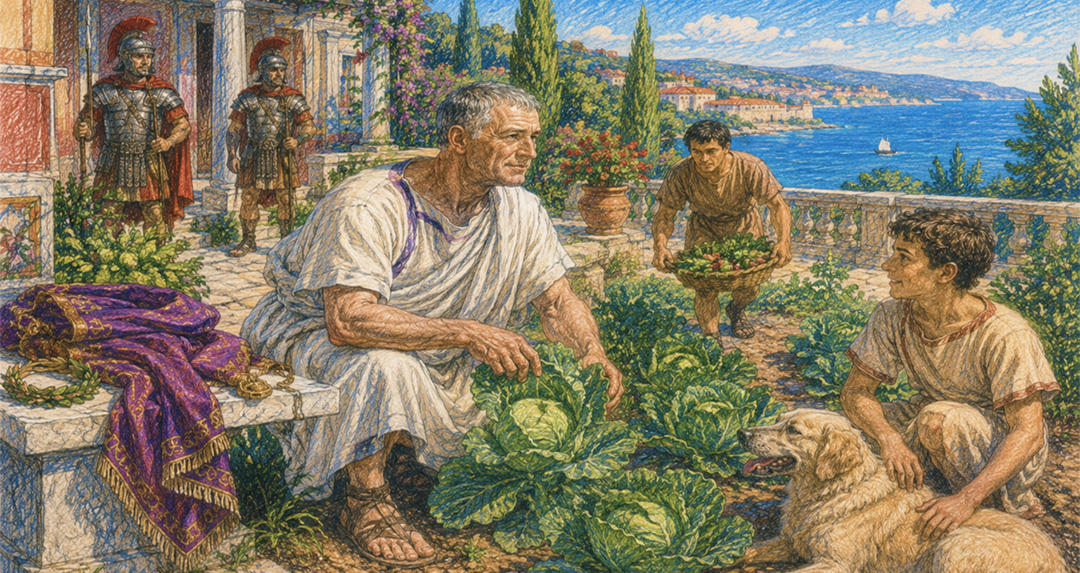
In the year 305, a man did a thing no Roman emperor had ever done, and none would convincingly do again: he stepped down. Diocletian, who had dragged the empire back from the edge of dissolution and reorganized the known world to suit himself, laid the purple aside and went home to the Dalmatian coast to garden. He was not deposed. He was not dying. He stood, by every measure his contemporaries understood, at the very top of the wheel; and from that summit, with the entire warm machinery of power still in his hands, he climbed down of his own accord and picked up a spade.
The sequel is the part worth keeping. Some years on, with the tidy system he had built already grinding itself to pieces and his former colleagues at one another's throats, Maximian came to him and pressed him to take up the throne again. Diocletian is said to have replied that if the man could only see the cabbages he had raised with his own hands, he would never propose anything so absurd as trading them for power. He was not being coy, and he was not being humble. He simply preferred the cabbages.
The Goddess on the Rolling Sphere
The Romans kept a deity for exactly the force Diocletian had spent his life mastering and then, at the last, declined to serve. Fortuna stood upon a sphere and never upon level ground, because she was never meant to be relied upon; the rolling globe beneath her feet was the whole theology in a single image. Her wheel lifted men to the top and, with the identical indifferent turn, ground them under it. Sometimes she was shown holding a rudder, to remind you who was steering, and sometimes blindfolded, to remind you that she was not aiming.
Every man in a permanent lather of negotium, of business that never rests, is lashed to that wheel whether he confesses it or not, mistaking the motion for advancement, certain that the next revolution is the one that finally sets him down somewhere worth standing. Diocletian's genius was not that he reached the top; plenty of men reach the top, which is generous that way, briefly. His genius was that he understood what almost no one does, which is that the top of the wheel is still the wheel, and he got off.
Here is the distinction our two house words were built to carry. Fortuna is the wheel and the wheel's gifts: every one of them on loan, none of them yours, all of them revocable the instant the rim comes round. Felicitas is the cabbage patch: a contentment rooted in soil you turn with your own hands, serenely uninterested in which way the thing happens to be spinning back in Rome. The man of negotium spends his single life petitioning Fortuna for a better seat on her wheel. The man of otium has quietly stepped onto the ground she never stands on, and discovered, to his lasting surprise, that it holds his weight.
The King Who Could Not Get Off
If Diocletian is the portrait, Pyrrhus is the cautionary panel beside it.
Plutarch hands us a small scene that ought to be carved over every ambitious desk. Pyrrhus, king of Epirus and one of the finest soldiers of his age, was preparing to sail against Rome. His adviser Cineas, a clever and civilized man, drew him into conversation. And if we defeat the Romans, Cineas asked, what shall we do then? Why, said the king, all Italy will be ours. And after Italy? Sicily lies near, and is ripe for the taking. And after Sicily? Then Libya, then Carthage, then Macedonia, then the whole of Greece. And when every last province is ours, Cineas pressed, what shall we do then? Here the king laughed and said: then, my dear Cineas, we shall take our ease, and drink, and keep one another good company. To which Cineas put the only question that mattered: and what, sir, prevents us from taking our ease and drinking now?
The king had no answer, because there is none. Cineas had caught negotium in the act of chasing its own tail around Fortuna's wheel. The rest Pyrrhus wanted was forever to be purchased by one more conquest, and the one more conquest, once won, only ever uncovered the next. He could not see the thing Diocletian saw, which is that the ease at the end of all the striving and the ease available this very afternoon are the same ease, and that the entire bloody apparatus erected between them buys a man precisely nothing he does not already have within reach.
The Romans observed all of this. What they could not do was measure it. We can. And it happens that every time the modern laboratory has tried to put a number on the cost of trying too hard, it has come back and handed the ancients their verdict.
What the Laboratory Found
Begin with the white bear. In the 1980s a psychologist named Daniel Wegner asked people to sit quietly and, whatever else they did, not to think of a white bear. They thought of almost nothing else. The harder a mind labors to suppress a thought, the more insistently the thought returns, because some part of the brain must keep checking whether the forbidden item has surfaced, and the checking is itself a summoning. Wegner called it ironic process, and the lesson is precise and merciless: the direct, effortful attempt to force a mental state tends to produce its opposite. The man who grits his teeth and orders himself to be calm has just guaranteed, by the very act of ordering, that he will not be.
The body keeps the same accounts. More than a century ago Robert Yerkes and John Dodson drew the curve that still carries their names: performance climbs with arousal up to a point, and then falls off a cliff. A little pressure sharpens you; past the crest, every further increment makes you worse, and on the hardest tasks the crest comes early. The contemporary work on choking, much of it from the psychologist Sian Beilock, supplies the mechanism. Hand a skilled performer enough at stake and he begins to monitor consciously what he had long since learned to do without thinking, and the monitoring jams the works. The golfer who attends to his own grip yips the putt; the pianist who thinks about her fingers stumbles. Competence, once it is genuinely yours, runs best when the anxious supervisor is sent out of the room.
The cleanest demonstration of all is the one you can run tonight, in your own bed. Ask any clinician who treats insomnia and he will tell you that the effort is the disorder. The harder a person tries to fall asleep, the more reliably he stays awake, because trying is a species of vigilance and vigilance is the sworn enemy of sleep. The standard remedy is almost insolent in its simplicity: the patient is instructed to abandon the attempt altogether, even to lie there and try gently to remain awake, at which point sleep, no longer being hunted, wanders back of its own accord. Viktor Frankl gave the maneuver a name, paradoxical intention, but the insight it rests on is far older than the clinic. It is otium, observed under fluorescent light.
And the released mind does not merely stop sabotaging itself; it sets to work. Anyone ambushed by the answer to a problem in the shower, or halfway through a walk, or in the drowsy minute before sleep, has felt the incubation effect, which the research confirms again and again: step away from a stubborn problem and the rate at which you solve it tends to go up, not down. The brain keeps a network that comes online precisely when you stop directing it, and it appears to do some of your finest work while your back is turned. The solution you could not seize by force arrives, unbidden, the instant you quit reaching for it. The watched pot, a Roman might have said, was only ever the lid held down by anxiety.
Beneath all of it sits a plain physiological fact, named in our own era by the Harvard cardiologist Herbert Benson. The body that owns a fight-or-flight gear owns the opposite gear as well: a measurable condition of lowered pressure, slowed pulse, and quieted alarm that Benson called the relaxation response. It is not the absence of action. It is a distinct and active state, the body's own otium, and the man who can enter it on purpose carries a physiological instrument the white-knuckled striver has forgotten he ever owned.
Assume, and Then Let Go
This is where the law of assumption stops sounding like mysticism and starts sounding like the only sane reading of the evidence.
To assume the wish fulfilled, in Neville's phrase, is to settle the question. And a settled question is the single thing that switches off every saboteur the laboratory has catalogued. The mind that has genuinely assumed its end is no longer suppressing the white bear, because it has stopped warring with the doubt; it has simply concluded. It is not monitoring its own grip, because it is not auditioning for an outcome still in question. It is not lying awake chasing the result, because in its own reckoning the result is already in hand. The arousal eases back to the productive stretch of the curve. The incubating mind is freed to do its quiet carpentry. The relaxation response, the body's otium, is permitted at last to switch on.
The release, then, is not the loss of anything. It is the removal of the interference. And here a caution the Romans would have insisted upon, and one I have drawn out at length in Otium cum Dignitate: the letting-go is not collapse. The man who simply quits, who releases his standards along with his grip and lets the inner house fall to seed, has not entered otium; he has wandered into idleness, which is a different country with a worse climate. Diocletian did not abandon his garden. He tended it with the same care he had once lavished on the empire, only without the empire's anxiety. The released state is a tended stillness, never a surrender; the hand that lets go of the result is the very hand that keeps a quiet, dignified watch over the mind. That watch is the dignitas in otium cum dignitate, and it is the whole of what separates the free man at his ease from the bum on the bench, who from across the room can look so deceptively alike.
Fortuna's wheel, in the end, turns exactly the same for the petitioner and for the man in his cabbage patch. The difference is not in the wheel. It is that one of them is exhausting himself trying to steer a thing that was never his to steer, while the other has taken his hands off it and put them in the soil, where, as every gardener and every contented mind eventually learns, the real work was waiting to be done all along.
Mens movet mundum: the mind moves the world. But it does its moving, as the Romans knew and the laboratory has at last confirmed, not from the top of the wheel, in the frenzy of negotium, but from the cabbage patch, in the cultivated calm of a man who has remembered how to assume the thing is done, and then, with dignity, let it go.